
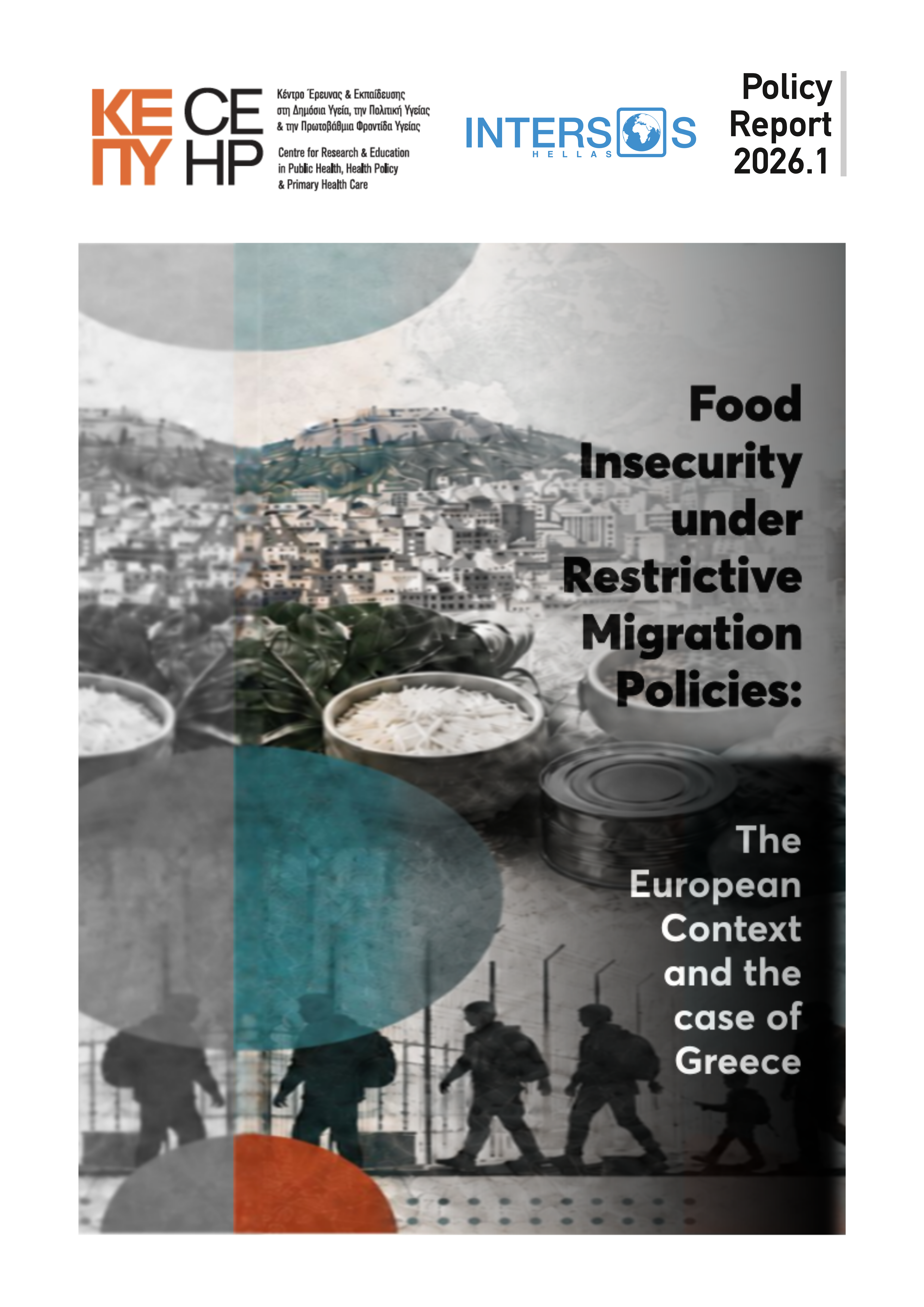
Food Insecurity under Restrictive Migration Policies: The European Context and the case of Greece.
.
Food Insecurity under Restrictive Migration Policies: The European Context and the case of Greece. Policy Report 2026.1.
Authors: Karl Philipp Puchner, Dimitrios Papanikolaou, Apostolos Veizis, Christos Ananiadis , Valia Kypraiou, Viktoria Zygouri, Alexis Benos and Elias Kondilis
Suggested citation: Puchner KP, Papanikolaou D, Veizis A, Ananiadis C, Kypraiou V, Zygouri V, Benos A, Kondilis E. Food Insecurity under Restrictive Migration Policies: The European Context and the case of Greece. Policy Report 2026.1. Thessaloniki: Centre for Research & Education in Public Health, Health Policy & Primary Health
Care (CEHP) – INTERSOS HELLAS. 2026
1. Introduction
The European and Greek refugee and migrant context
The European Union (EU) constitutes a major destination for complex and forced migration movements, involving people with highly diverse demographic profiles arriving primarily from Sub-Saharan Africa, the broader Middle East, and the Indian subcontinent. In this context, Greece, has consistently served as one of the main entry points at the EU’s external borders. In 2015, refugee and migrant (R&M) arrivals in the EU exceeded one million, with Greece recording approximately 856,723 arrivals. While arrivals declined significantly in the following years, they have since stabilized at several tens of thousands annually. Indicatively, approximately 62,119 arrivals were recorded in 2024 (UNHCR, n.d.), while in 2025, Greece recorded approximately 52,180 arrivals and 55,383 asylum applications (Refugee Support Aegean [RSA], 2025).
Despite significant mixed complex and forced migration being a long-established fact in the European context and a potential response to demographic decline and labor market challenges, migration governance across the EU and Greece has largely failed to reflect this reality (Bacci ML, 2018). R&Ms in the EU, in addition to being subject to increasingly restrictive migration policies overrecent decades and xenophobic rhetoric in the public sphere, experience substantial structural socioeconomic disadvantages (Hernes V, 2026; O’Brien, P, 2025). Statistics consistently reveal that nearly one in two non-EU citizens residing in the EU and Greece is at risk of poverty or social exclusion, suggesting persistent barriers to social integration and limited opportunities for upward social mobility (Eurostat, n.d.). In line with this data, the recently published Migrant Integration Policy Index (MIPEX) report highlights that integration policies in the 27 EU countries are, on average, only halfway favorable – and thus largely impeding opportunities of R&Ms communities to fully participate and flourish in their new home countries. Greece, in particular, scores below the already suboptimal European average on migrant integration policies. Equity in employment, housing, and education is largely guaranteed on paper but remains inadequately implemented in practice, with substantial discrimination against R&Ms persisting. At the same time, R&Ms remain almost entirely excluded
from access to nationality and opportunities for political participation (MIPEX, 2025).
Finally, the implementation of the EU Pact on Migration and Asylum, which entered into application in June 2026 and introduces an even more restrictive framework centered on fast-track screening, de-facto mass detention, and strengthened border management and return mechanisms, is likely to further exacerbate the material and legal precarity of R&Ms arriving in and residing across the EU (MSF, 2025; RSA, 2024).
Food insecurity: definitions and significance
Food security is defined as a situation in which “all people, at all times, have physical, social and economic access to sufficient, safe and nutritious food that meets their dietary needs and food preferences for an active and healthy life”. The Food and Agriculture Organization of the United Nations (FAO) recognizes in addition to food availability in sufficient quantities, food quality, affordability, nutritional adequacy and stability of storage and supply as crucial pillars of food security.
Thus, food insecurity encompasses not only reduced food availability, commonly associated with acute humanitarian crises and regions affected by conflict and political instability, but also limited socio-economic access to safe and nutritious food as well as restricted storage capacities and supply
stability (FAO, 2023; FAO, 2008; FAO, 2011).
Food insecurity may have both direct and indirect detrimental effects on the lives of affected individuals. Its socio-economic consequences, including extremely difficult trade-offs between competing basic needs (e.g., food and shelter), contribute to poverty, marginalization and social exclusion. Moreover, food insecurity erodes health, particularly among children, and is therefore regarded as a major risk factor for impaired childhood development and poor physical and mental health in adulthood. Epidemiologically, malnutrition, in its various forms and manifestations (e.g., underweight, wasting, stunting, micronutrient deficiencies, and obesity) and its well-documented multifaceted adverse health consequences, constitutes one of the most reliable indicators of prolonged and/or repeated exposure to food insecurity, reflecting its cumulative and often devastating impact on health (Freedman DA et al, 2013; Gallegos D, 2025).
2. Food insecurity among refugees and migrants in Europe and Greece: a major public health and societal concern
Understanding the dual nature of vulnerability
Evidence suggests that R&Ms are particularly vulnerable to food insecurity (Anderson L, 2014; Crush J, 2017). Building on the FAO definition, food insecurity among R&Ms should be understood as an outcome shaped not only by the aspect of availability but rather by the conditions through which food is accessed, utilized and stored over time (FAO, 2008; FAO, 2011). In this sense, the level of food security is closely linked to the wider material and institutional environment in which R&Ms live,
including aspects such as housing, income, legal status, access to employment, healthcare, social protection and welfare systems. Although R&Ms in the EU and Greece are rarely exposed to humanitarian crisis settings characterized by actual food scarcity, they often face multiple drivers of food insecurity (WHO Regional Office for Europe, 2018; WHO, 2022a). In this context, it is also noteworthy that difficulties in securing adequate and nutritious food are not confined to R&M populations in the EU, but rather reflect broader patterns of poverty, socioeconomic disadvantages, and social marginalization. Eurostat data for 2024 show that this problem is more pronounced in Greece than the EU average, and substantially higher among people at risk of poverty (Eurostat, 2025). Concretely, in 2024, inability to afford an adequate meal every second day was higher in Greece than the EU average, and substantially higher among people at risk of poverty (Table 1). This shows that food insecurity is closely linked to poverty and social exclusion—to which R&Ms are disproportionately exposed—even before considering the additional barriers they face.
Table 1. Food affordability as a marker of social inequality in the EU and Greece
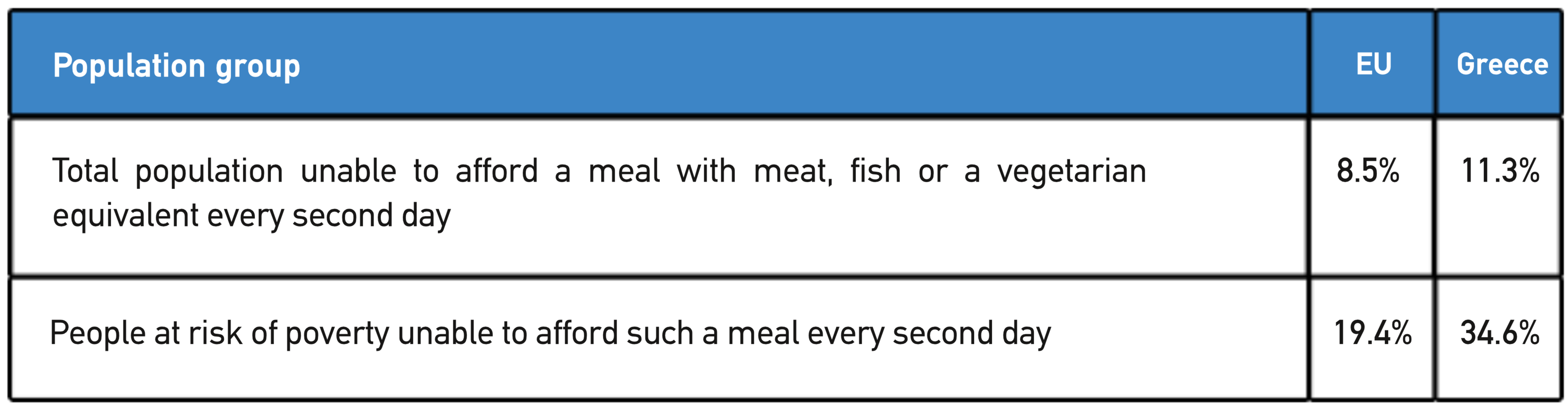
Source: Eurostat (2025), “One in 12 people in the EU cannot afford a meal with meat, fish or a vegetarian equivalent every second day”.
Indeed, increased vulnerability of R&Ms to food insecurity stems, among others, from context-specific factors, such as the multiple concurrent socioeconomic pressures due to incomplete integration and resulting limited social welfare access, that force trade-offs between food acquisition and the fulfilment of other basic needs, such as housing and transportation. These challenges are often further compounded by legal uncertainty, administrative barriers, and limited access to stable employment and healthcare (WHO Regional Office for Europe, 2018; WHO, 2022b). It should also be acknowledged that food insecurity among R&Ms may arise or be exacerbated at multiple stages of the migration trajectory, extending from the pre-migration phase through arrival and reception to attempted integration into urban settings (Abdalla and Goulao, 2024). This is why food insecurity among R&Ms should not be examined solely as a question of food distribution, but also as a function of the material and institutional conditions that enable or constrain access to, utilization of, and storage of adequate and nutritious food. (Abdalla and Goulao, 2024; WHO, 2022).
The major public health relevance of food insecurity is reflected in the highly prevalent nutrition-related disorders observed among displaced populations. In this light, The Office of the United Nations High Commissioner for Refugees (UNHCR) treats food security and nutrition as central components of public health responses, particularly in relation to the prevention and treatment of malnutrition, micronutrient deficiencies and nutrition-related risks among infants, children and mothers (UNHCR, n.d.). Evidence from Europe suggests that newly arrived R&M children may already present severe and complex nutritional needs at the point of arrival, following prolonged or repeated exposure to food insecurity, deprivation and disrupted access to food and health care (Young et al., 2004). The available literature does not point only to undernutrition, but to a double or even triple burden of malnutrition, where undernutrition, overweight or obesity and micronutrient deficiencies
may coexist in the same population, household or even individual under investigation (WHO, 2018; Ankomah A, 2022). In Greece, Grammatikopoulou et al. found at least one form of malnutrition among 13% of children living in two reception centers in the Northern region of the country (Grammatikopoulou et al., 2019). Similarly, Walpole et al. documented the coexistence of overweight, stunting and wasting among children living in four refugee camps in Northern Greece, highlightingthat complex and overlapping nutritional vulnerabilities may already be present during the early reception phase (Walpole SC et al., 2018). This public health framing further supports the understanding of food insecurity among R&Ms not merely as a problem of food provision, but as a socially determined outcome shaped by the broader material, legal, and institutional conditions under which people are expected to live and integrate.
Conceptual framework: from food provision to structural access
In R&Ms contexts, access to food often depends on a combination of humanitarian assistance, reception arrangements, legal entitlements, social networks and market access (Abdalla and Goulao, 2024). From a public health perspective, food insecurity matters not only because it affects nutrition, but also because it increases vulnerability to poor health, worsens existing conditions and reflects gaps in prevention, social protection and access to services (WHO Regional Office for Europe, 2018; WHO, 2022a). The framework developed by Abdalla and Goulao is particularly useful because it links food insecurity in refugee settings to interacting immediate, secondary and structural causes, including inadequate shelter, limited food assistance, poor access to healthcare and water, sanitation and hygiene (WASH), low income, weak social support, transport barriers and restrictive policy or legal frameworks (Abdalla and Goulao, 2024). This helps move the analysis beyond food distribution alone and towards the broader systems that enable or prevent people from securing adequate food. Based on the foregoing analysis, we argue that restrictive migration policies constitute an important structural determinant of food insecurity throughout the migratory cycle, particularly during the arrival and integration phases. This effect is not always direct: migration policies do not necessarily restrict availability of food itself or direct access to it. Rather, they may restrict or destabilize the conditions through which food is normally secured, utilized and stored, such as accommodation, lawful stay, documentation, financial assistance, access to work, social-security registration, healthcare and welfare support (WHO Regional Office for Europe, 2018; WHO, 2022; Abdalla and Goulao, 2024). This means that food insecurity can be understood as a downstream effect of migration governance with distinct effects depending on the phase of the migratory process.
Arrival phase: reception conditions and immediate food access
In the arrival phase, the link between migration policy and food insecurity is relatively direct. Newly arrived are often highly dependent on official reception systems for accommodation, food provision within state reception structures, state-provided cash assistance and access to basic services. In Greece, material reception conditions for asylum seekers formally include accommodation, food in kind and financial support for daily needs (Ministry of Migration and Asylum, n.d.). This means that when reception is delayed, inadequate or exclusionary, the consequences for food access can be immediate, leaving R&Ms depending on institutional meals exclusively with little or no possibility of choosing or supplementing food, that is culturally appropriate or nutritionally adequate. This matters especially in camps and other reception settings under the Reception and Identification Service (RIS) of the Greek Ministry of Migration and Asylum (MoMA), where food access is shaped not only by formal entitlements, but also by the practical organization of daily life. Residents may be far from urban centers, markets and services, with limited transport options and limited capacity to buy, store or prepare food independently (RSA, 2024c; RSA, 2025). In this context, the existence of food distribution does not automatically mean that people are food secure. Food may be available, but still insufficient, difficult to access, inadequate in quality or variety, culturally inappropriate, or not adapted to specific health and nutritional needs (FAO, 2008; FAO, 2011; CPT, 2024). This association is reflected in reporting on reception conditions in Greece. Following its 2023 visit, the European Committee for the Prevention of Torture and Inhuman or Degrading Treatment or Punishment (CPT) described food distribution in Samos Closed Control Access Center (CCAC) as chaotic and undignified, with hundreds of people jostling to obtain their portion, and linked this to broader concerns about living conditions in reception sites (CPT, 2024). Refugee Support Aegean (RSA) has also documented that reception in camps in Greece continues to be marked by inadequate living conditions, lack of financial allowances and geographic isolation from urban centers, all of which can directly or indirectly impact negatively on food security (RSA, 2024a; RSA, 2024c; RSA, 2025). In reception settings, food provision, WASH, primary healthcare, and vulnerability screening should be treated as interconnected components of a comprehensive public health response. Weaknesses in one domain can undermine the others by compromising food utilization, delaying the identification of nutrition-related and medical needs, and limiting access to food assistance (FAO, 2008; FAO, 2011; CPT, 2024). This is particularly important because R&Ms, especially children and unaccompanied minors, may arrive with complex nutritional needs resulting from prolonged deprivation, displacement, detention, violence, or interrupted access to healthcare (Young et al., 2004). Reports of severe malnutrition among newly arrived children in Greece underscore the need to integrate nutritional assessment into the initial public health response, rather than delaying it until legal or administrative procedures have been completed (Grammatikopoulou et al., 2019; Walpole et al., 2018; WHO, 2018). Thus, food insecurity at the arrival phase should be understood not only as a consequence of individual vulnerability, but as an outcome of reception conditions and practices that determine access to food, income, WASH, healthcare and protection.
"Integration" phase: formal inclusion without material security
Food insecurity among R&Ms cannot be explained solely by conditions during arrival and reception. Restrictive migration policies may also undermine food security during the integration phase. Once individuals leave reception or accommodation facilities, they are expected to meet their food needs through the market, as does the local population (RSA, 2025). Yet this transition is often incomplete. In restrictive policy settings, reception support— which is often inadequate—may be withdrawn before R&Ms achieve meaningful inclusion in employment, welfare, and housing systems (RSA, 2024a; RSA, 2025). This creates what can be described as a “post-reception trap”: people are expected to become self-reliant before the conditions for real self-reliance are in place. Access to food depends on the ability to secure income, housing, documentation, healthcare, social protection and access to services, all of which may remain unstable or conditional for R&Ms even when entering the integration phase (WHO Regional Office for Europe, 2018; WHO, 2022a). As a result, people may formally move forward in the migratory cycle, while still lacking the material conditions required for actual self-reliance (RSA, 2024; RSA, 2025). Integration related food insecurity challenges are particularly evident in cities such as Athens, where nutritious food is primarily accessed at high prices through super-markets and where households must simultaneously manage high housing and living costs, while relying on unstable and often precarious informal sector employment. (AIDA, 2025; RSA, 2025). Furthermore, the institutional fragmentation of the integration process constitutes an additional obstacle to a smooth transition towards independent living. The Greek case is once again highly illustrative of the erosive effects of institutional fragmentation on the integration process. Access to social benefits, housing programs, and the labour market often depends on navigating multiple bureaucratic requirements, many of which are mutually dependent or, at times, mutually exclusive. As a result, progress along the integration pathway becomes highly volatile and difficult to sustain (RSA, 2026b). For example, activation of the social security number (AMKA) —a prerequisite for accessing employment and public healthcare—simultaneously results in the loss of eligibility for several housing and integration support programs. Rather than facilitating integration, institutional progress in one domain may therefore come at the expense of support in another, illustrating how fragmented policy design can undermine the integration process itself. Under these circumstances, food insecurity may persist or worsen during the integration phase. Rather than reflecting individual failure, it is a consequence of incomplete integration, legal precarity, housing exclusion, and limited access to welfare and employment. Food insecurity therefore reflects gaps at the intersection of migration, health, and social policies and should be analyzed through the intersectoral policy frameworks governing all dimensions relevant to the successful integration of R&Ms.
Migration policy developments in Greece and the association to urban food insecurity in R&Ms
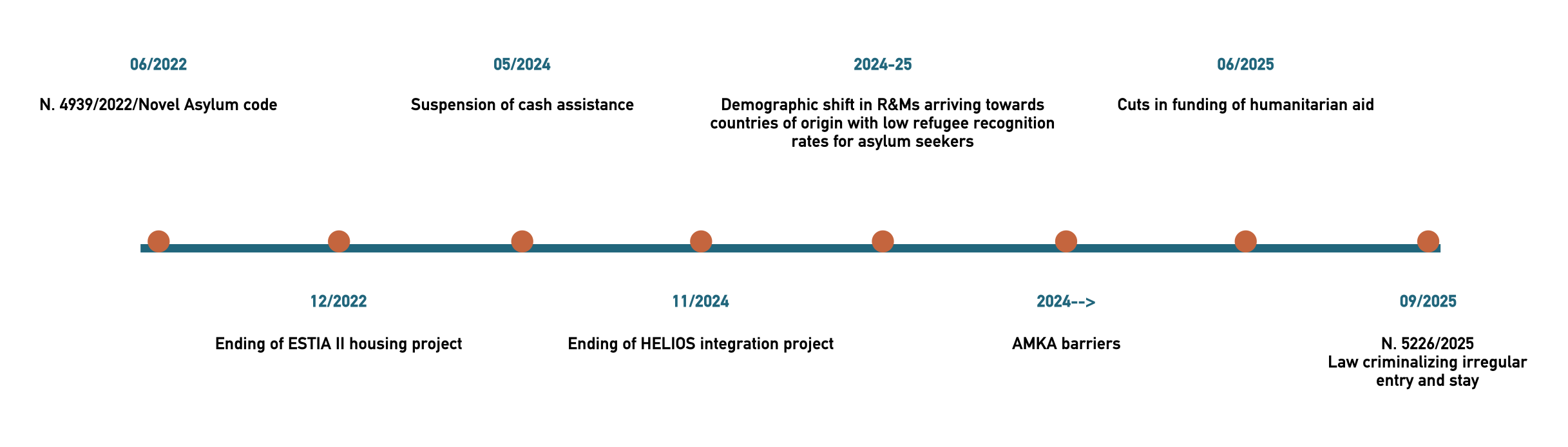
The Greek case illustrates how migration and reception policies can shape food insecurity by affecting the conditions through which R&Ms access housing, income, documentation, employment, services and social protection (summary of policy changes and relevant developments provided in Figure 1). Law 4939/2022, which provides extensive provisions for the detention of asylum seekers while offering significantly fewer safeguards against the imposition of detention measures, is not a food policy per se. Nevertheless, it matters for food security because asylum seekers’ access to food is embedded within the broader reception framework, including accommodation, material support, and reception conditions. (AIDA, 2024). It therefore provides the institutional background against which later forms of material insecurity developed. The end of the ESTIA II urban accommodation program in late 2022 is particularly important for an urban context such as Athens. Urban accommodation is not only a housing issue but also a foodsecurity issue, as it affects whether people can cook, store food, remain close to services and avoid homelessness or forced reliance on camps, charities and emergency coping strategies (RSA, 2022). The closure of ESTIA II therefore likely weakened the conditions through which R&Ms could secure food in a stable and dignified way (RSA, 2022). A related development concerns the HELIOS programme, which was designed to support the integration of beneficiaries of international protection, including through housing-related assistance. Its interruption from January 2024 and subsequent termination at the end of November 2024 further weakened the already limited transition from reception structures to urban self-reliance (RSA, 2024b; RSA, 2025). In practice, this meant that people leaving reception or attempting to stabilize their lives in cities such as Athens, faced fewer housing and integration supports, increasing the risk of homelessness, destitution and reliance on ad hoc assistance for basic needs, including food (RSA, 2024b; RSA, 2025).
The suspension of cash assistance for asylum seekers since May 2024 is another key example of how policy changes can affect food access directly. Since this assistance was intended to cover basic daily needs, including the ability to buy food and other essentials, its suspension reduced household purchasing power and limited people’s capacity to supplement institutional food provision or meet specific dietary needs (Ministry of Migration and Asylum, n.d.; RSA, 2024a). This is especially important in urban settings, where access to food depends primarily on market access and therefore on the availability of income or other forms of financial support (RSA, 2024a; FAO, 2011).
Documentation and social-security barriers also affect food insecurity indirectly but substantially. RSA has documented persistent bureaucratic obstacles in the activation of AMKA for recognized beneficiaries of international protection, with AMKA being essential for access to employment, healthcare and other social services (RSA, 2025). AIDA and ECRE further note that AMKA is required for access to social welfare benefits and homeless shelters, meaning that non-activation or deactivation can block not only healthcare and access to the labour market, but also key routes to subsidies and social benefits, housing stability and protection from destitution (AIDA, 2025). For households in Athens, these barriers matter because they reduce the ability to secure formal employment, maintain income and avoid emergency coping strategies that undermine regular access to food (AIDA, 2025; RSA, 2025).
The expanding use of safe country of origin (SCO) lists in Greece and across the EU is also relevant to the production of food insecurity. By reducing the likelihood of international protection and accelerating asylum procedures for applicants from designated countries, SCO policies may increase legal precarity and limit access to reception conditions and other forms of social support. The European Union Agency for Asylum (EUAA) reported that, in 2024, almost half of all asylum applications in the EU+ were lodged by nationalities with low recognition rates, while data from the Greek Ministry of Migration and Asylum show that Egypt—designated as a safe country of origin under Greek asylum law—became the second-largest nationality of asylum applicants in Greece in 2025 (EUAA, 2025; Ministry of Migration and Asylum, 2025). These developments suggest that an increasing proportion of asylum applicants may face greater risks of prolonged legal and material insecurity, with important implications for food security. In the Greek urban context, this matters because a larger presence of applicants with lower recognition prospects may translate into more people exposed to rejection, insecure stay, weaker entitlements and prolonged precarity, all of which can heighten vulnerability to food insecurity (EUAA, 2025; Ministry of Migration and Asylum, 2025). These pressures were compounded by the contraction of humanitarian support. In 2025, UNHCR warned that severe funding shortfalls were forcing it to scale back programs, including in Greece, and that cuts to legal assistance, livelihoods and other support services could leave R&Ms without access to asylum and basic support (UNHCR, 2025). In a context where many R&Ms in Athens already relied on NGOs and civil society actors to cover food and other essential needs, the shrinking of this support environment has likely reduced household coping capacity and increased exposure to food insecurity (UNHCR, 2025).
Finally, the reform introduced in September 2025 through Article 27 of Law 5226/2025 significantly tightened the criminal-law treatment of irregular entry into, exit from, and stay in Greece (RSA, 2026a). According to RSA, the provision led to hundreds of prosecutions and convictions within a few months, while almost 300 people remained deprived of liberty at the end of 2025 after conviction for these offences (RSA, 2026a). In urban contexts such as Athens, the consequences go beyond detention itself: the threat of arrest, prosecution or imprisonment may push people with insecure status away from public institutions and formal support systems, reduce their ability to seek work, interrupt income, weaken housing stability and increase reliance on emergency or ad hoc assistance (RSA, 2026a). This shows how criminalization can worsen food insecurity indirectly, by making everyday survival more precarious and by cutting people off from the resources through which food is normally accessed (RSA, 2026a).
Figure 1. Timeline of policy changes and relevant developments
Policy outlook and the Athens case study
Overall, the conceptual argument developed here is that restrictive migration policies shape food insecurity by unfavorably influencing access to the material and institutional conditions through which food is obtained, stored and utilized. During the arrival phase, the main determinants include reception conditions, food provision, accommodation, WASH, cash assistance, access to basic services, and the early identification of nutritional needs. During the integration phase, factors influencing food security include access to documentation, employment, housing, welfare, healthcare, and social security, as well as the risk of prolonged urban precarity. Food insecurity should therefore be understood not merely as a problem of food provision, but as a public health and social policy outcome reflecting inadequate reception and incomplete integration. This analysis is particularly relevant and timely in the context of the implementation of the aforementioned EU Pact on Migration and Asylum, which entered into application in June 2026. From a food-security perspective, these developments matter because policies that increase legal uncertainty, containment, rejection risks or delayed access to rights may also affect the material conditions through which people secure food, housing, income and access to the welfare state. The Athens case study presented below demonstrates that food insecurity among refugees and migrants (R&Ms) extends beyond refugee camps and emergency settings into the urban environment, where it is shaped by restrictive migration policies, housing exclusion, documentation barriers, labour-market precarity, limited welfare and healthcare access, and shrinking humanitarian support. This framework informs the interpretation of the Food for All project data in the context of evolving Greek and EU migration policies.
3. Athens case study: the project “Food for All”
Setting and project profile:
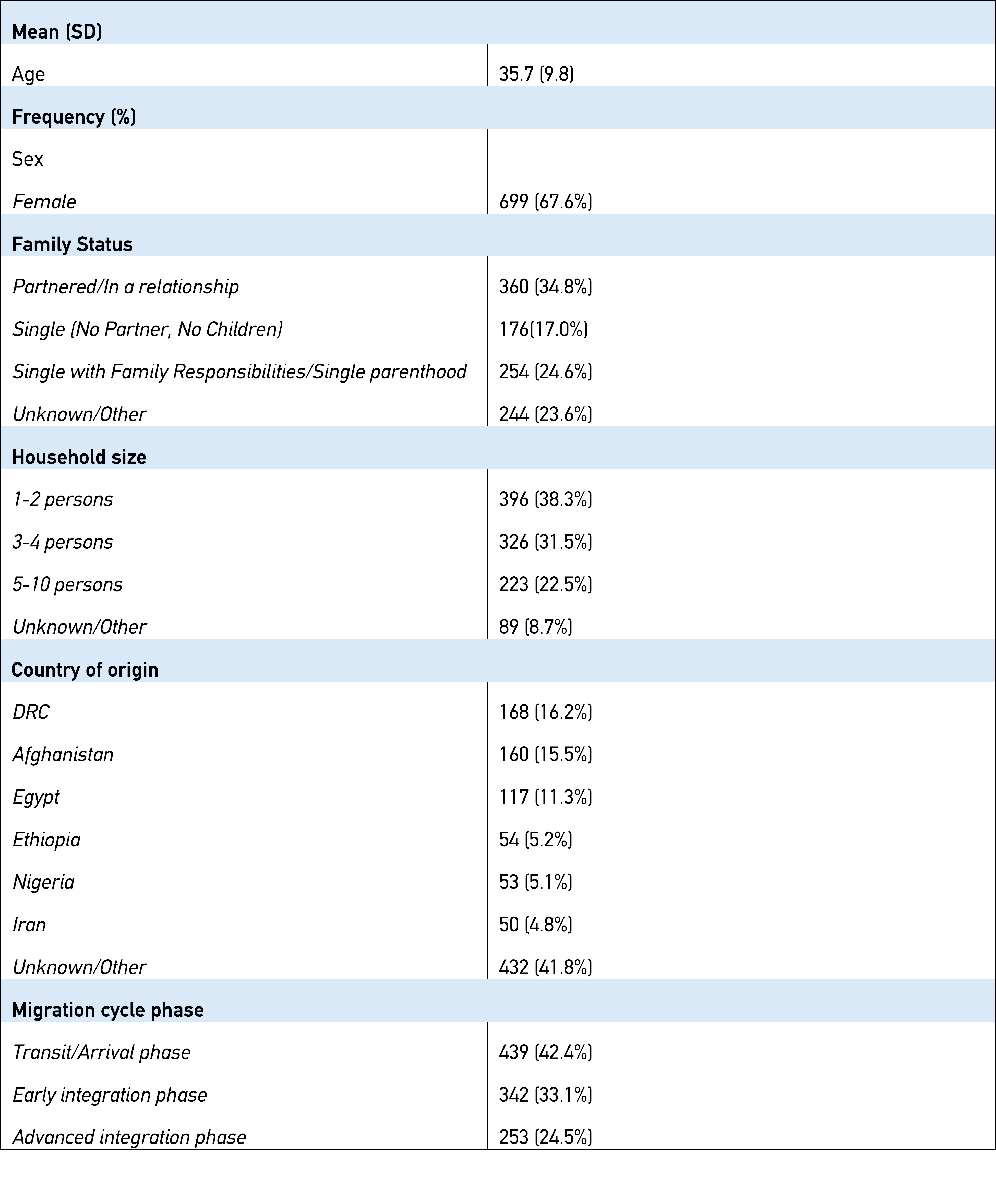
Athens is a major urban hub along the Eastern Mediterranean and Balkan migration route, serving as a key point of arrival, transit, and settlement for R&Ms. As Greece's economic and administrative center, it hosts the country's largest and most established migrant communities. The broader metropolitan area also includes five of Greece's largest refugee camps, many of whose residents regularly commute to Athens (RSA, 2026b; Ministry of Migration and Asylum, 2025). Yet, despite its central role in the country's migration landscape, national policies provide little support for the integration of R&Ms into the social and economic fabric of the capital. As illustrated by the migration policy changes discussed earlier, recent reforms have progressively narrowed reception and integration opportunities. This policy orientation culminates in the 2022 National Integration Strategy, which prioritizes the settlement of R&Ms in remote agricultural areas over measures that facilitate their integration into urban centers (Ministry of Migration and Asylum, 2022). The project Food for All, initiated by the NGO INTERSOS HELLAS in December 2021, provides holistic support and advocacy for R&Ms, including the provision of food assistance (INTERSOS Hellas, HIAS Greece, & Greek Council for Refugees, 2023). The project prioritizes households and individuals experiencing housing insecurity and legal precarity, however without excluding R&Ms with legal documents and/or valid residence permit. Between February 2022 and November 2025, the project enrolled 1,034 unique primary beneficiaries, delivering food assistance that supported a cumulative total of over 23,000 household members across all distribution rounds in Athens. Case study results: The majority of enrolled beneficiaries were women living with a partner or as single parents, although a notable proportion (17%) consisted of single adults without children. More than 50% belonged to households comprising three to ten members. Beneficiaries represented a wide range of countries of origin, with both Middle Eastern and Sub-Saharan African countries among the five most common. Based on the availability of documentation (e.g., AMKA), residence permit status, and the employment status of beneficiaries and other household members, participants were classified into three migration phases: Transit/Arrival, Early Integration, and Advanced Integration. Notably, more than half of the beneficiaries were classified as being in the Early or Advanced Integration phase (Table 2).
Table 2: Demographics of beneficiaries of “Food for All” program (Feb 2022-Nov 2025)
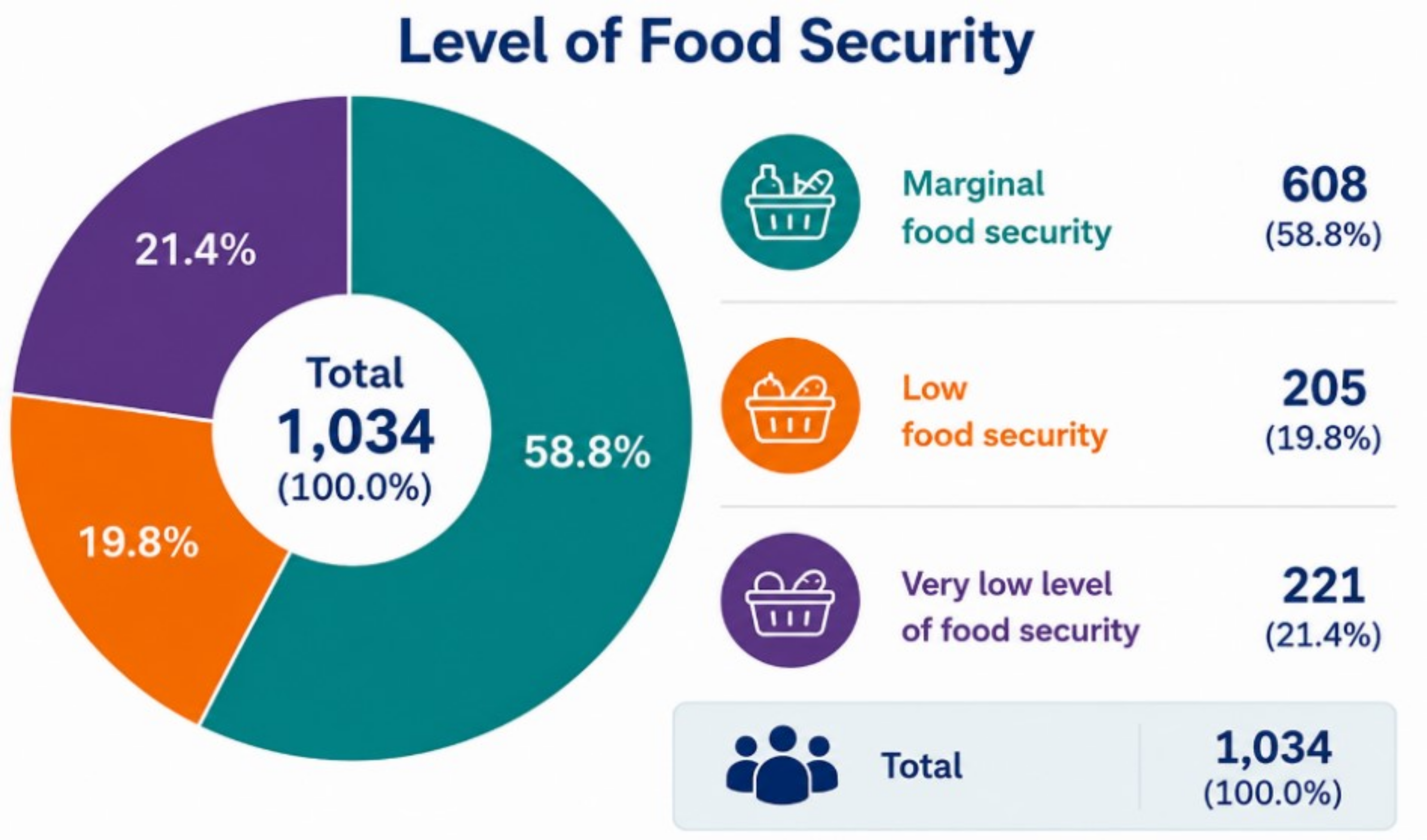
During the intake assessment, beneficiaries were asked the following questions to assess their food security status: (1) "Do you have regular access to nutritious and adequate quantities of food?" If the response was "No", they were subsequently asked: (2) "If no, on how many days per week do you not have access to nutritious and adequate quantities of food (1–7)?" Based on these responses, a composite variable was constructed to classify beneficiaries into three food security categories. Beneficiaries who answered "Yes" to the first question were classified as having marginal food security. Those who answered "No" to the first question and reported lacking access to adequate and nutritious food on 1–3 days per week were classified as having low food security, whereas those reporting lacking access to adequate and nutritious food on 4–7 days per week were classified as having very low food security. According to this classification, more than 40% of beneficiaries experienced low or very low food security.
Figure 2
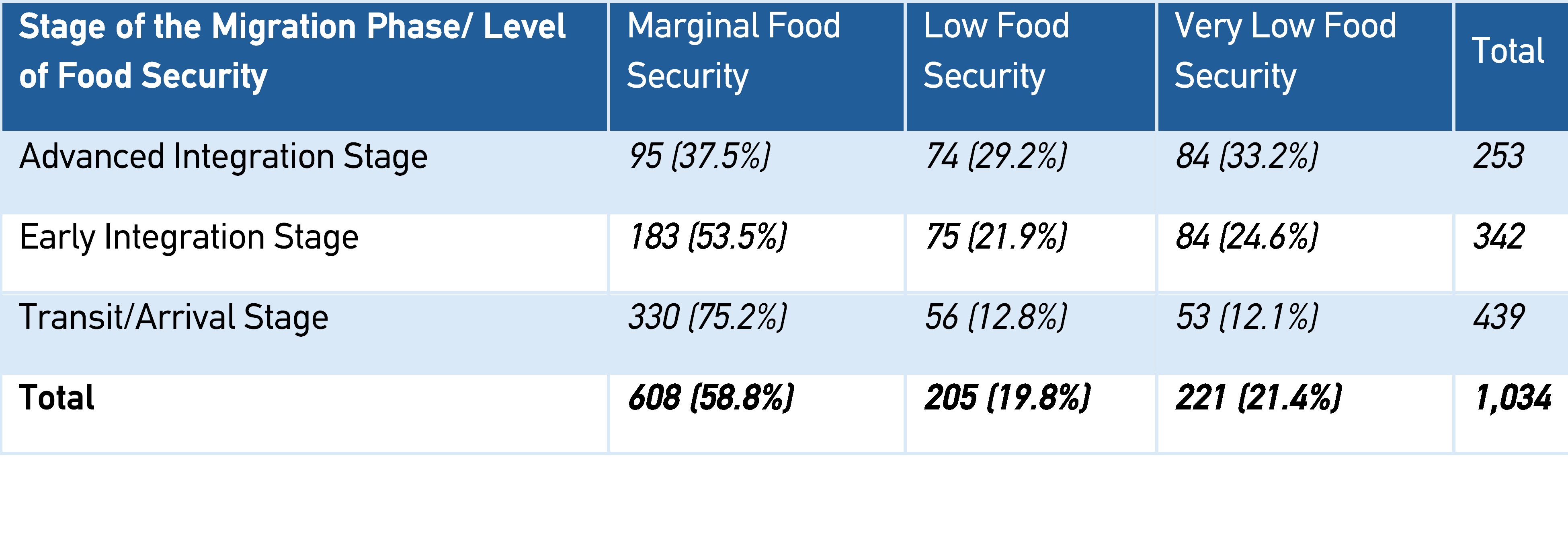
Finally, cross-tabulation of migration phase and food security status revealed that more than onethird of beneficiaries in the Advanced Integration phase experienced very low food security, representing a markedly higher proportion than in the other migration phases.
Table 3
4. Conclusions
F ood security is defined as a situation in which "all people, at all times, have access to adequate quantities of safe and nutritious food to lead a healthy and active life” (FAO, 2008). Achieving food security depends not only on the availability of food within a given spatial and temporal context, but also on a wide range of broader socioeconomic, legal, and institutional factors (FAO, 2023). R&Ms are particularly vulnerable to food insecurity, with evidence from multiple reception settings across Europe, and particularly Greece, demonstrating a high prevalence of severe and complex forms of malnutrition—one of the most reliable indicators of chronic food insecurity (Walpole SC, 2018; Grammatikopoulou MG, 2019; Ankomah A, 2022). However, this phenomenon is unlikely to be merely a reflection of food scarcity associated with displacement and migration. Rather, it represents the cumulative outcome of prolonged exposure to material and institutional conditions that constrain individuals' ability to acquire, store, and utilize adequate and nutritious food (Abdalla and Goulao, 2024). These constraints evolve across the different phases of the migratory trajectory, extending well beyond the pre-migration and transit phases into the arrival and integration phases. Food insecurity should therefore be understood not only as a consequence of displacement, but also as a structural outcome of the material and institutional conditions under which R&Ms are received, protected, and integrated (Crush J, 2017).
As previously highlighted in our conceptual analysis, restrictive migration policies – which, with few exceptions, tend to become predominant both in the European and Greek political landscape - can through direct and indirect pathways significantly deteriorate food security of R&Ms during both the arrival and integration phases. Restrictions on freedom of movement, inadequate living and cooking conditions in reception centers, provision of culturally inappropriate or poor-quality meals, limitation or abolition of cash assistance, and delays in vulnerability screening—as illustrated by the case of Greece—can substantially undermine the food security of refugees and migrants (R&Ms) during the arrival phase. Furthermore, the fast-forward self-reliance doctrine, increasingly embedded within restrictive migration reforms, requires R&Ms to rapidly achieve economic self-sufficiency while exiting reception systems with little or no institutional support. Thus, the integration phase is often characterized by worsening material conditions, urban precarity, and difficult trade-offs between food and other basic needs, resulting in a substantial deterioration in food security among R&Ms.
The findings of the case study from Athens presented in this policy brief seem to be in accordance with our conceptual analysis. Contrary to expectations, indicators of advanced integration—defined by possession of a social security number (AMKA), a valid residence permit, and employment of at least one household member—were not associated with improved food security. On the contrary, the proportion of beneficiaries reporting very low food security was higher among those classified in the Advanced Integration phase than among beneficiaries in the Early Integration or Transit/Arrival phases. This finding is consistent with the preceding analysis on the fragmentation of the integration process and the progressive decoupling of integration from institutional support mechanisms. It is also noteworthy that based on the findings of the project Food for All, food was sought by a demographically diverse population, suggesting that food insecurity affects a broad spectrum of R&Ms residing in Athens. The need for food assistance was not confined to traditionally vulnerable groups, such as large households or single-parent families, but was also evident among childless individuals and smaller households. Of particular interest is the severity of the food insecurity recorded, with over 40% of beneficiaries reporting that they were unable to access adequate quantities of nutritious food at least once a week.
Apart from the migration policy-specific upstream drivers analyzed in detail above, the findings might to some extent reflect as well unfavorable macro-economic developments. It should not be forgotten that, particularly at the early stages of the project, the erosive effects of the COVID-19 pandemic on the socio-economic status of vulnerable societal groups were still tangible, while throughout the project period, these challenges were further compounded by rising inflation in basic food items and exploding housing costs (ELSTAT, 2026; OECD, 2022).
Unfortunately, the combination of escalating living costs, new migration flows driven by growing geopolitical instability and climate change, and the further tightening of migration policies under the recently adopted EU Migration and Asylum Pact is likely to lead to a further deterioration of food security among R&Ms in Greece and across the EU.
Although some promising projects addressing material and nutritional deprivation of R&Ms during the integration process have been implemented across the EU (European Social Fund Plus, 2021), primarily at the local government level, a comprehensive and coordinated response is urgently needed to counter the impending food insecurity crisis affecting this population.
Concretely, at the governmental level, successful small-scale initiatives implemented primarily by local authorities to address material deprivation and food insecurity among R&Ms should be rigorously evaluated with regard to their scalability, transferability, and integration into national policy frameworks.
At the level of research and academia, further interdisciplinary studies investigating the extent of food insecurity and highlighting its specific health ramifications and overall socio-economic consequences in both R&M populations as well as the general population, should be prioritized.
At the civil society level, initiatives aimed at empowering R&Ms, promoting their political participation, and advocating for the reversal of restrictive migration policies should be strengthened and better coordinated across the EU.
Finally, at the broader societal and political level, efforts for advancing the right of R&Ms to food security and equitable integration should be embedded within wider struggles to preserve and expand welfare state provisions across the EU.security and equitable integration should be embedded within wider struggles to preserve and expand welfare state provisions across the EU.
References:
Abdalla, L., Goulao, L.F. (2024) “Food security and nutrition in refugee camps in the European Union: Development of a framework of analysis linking causes and effects”. Food Sec. 16, 735–755 (2024). https:// doi.org/10.1007/s12571-024-01440-5
AIDA (2024) Country Report: Greece, 2023 update. Database/European Council on Refugees and Exiles (ECRE).https://ecre.org/aida-country-report-on-greece-2023-update/ (Accessed: 20/05/26)
AIDA (2025) Country Report: Greece, 2024 update. Asylum Information Database/European Council on Refugees and Exiles (ECRE). Available at: https://asylumineurope.org/wp-content/uploads/2025/09/ AIDA_GR_2024-update.pdf (Accessed: 20/05/2026).
Ankomah A, Byaruhanga J, Woolley E, Boamah S, Akombi-Inyang B (2022). Double burden of malnutrition among migrants and refugees in developed countries: A mixed-methods systematic review. PLoS One. 2022 Aug 18;17(8):e0273382. doi: 10.1371/journal.pone.0273382. PMID: 35981085; PMCID: PMC9387835.
Anderson L, Hadzibegovic DS, Moseley JM et al. (2014) “Household food insecurity shows associations with food intake, social support utilization and dietary change among refugee adult caregivers resettled in the United States”. Ecol Food Nutr 53(3):312–332.
Bacci ML. “Does Europe need mass immigration?”, Journal of Economic Geography, Volume 18, Issue 4, July 2018, Pages 695–703.
Council of Europe, European Committee for the Prevention of Torture and Inhuman or Degrading Treatment or Punishment (CPT) (2024) “Report to the Greek Government on the visit to Greece carried out by the European Committee for the Prevention of Torture and Inhuman or Degrading Treatment or Punishment (CPT) from 20 November to 1 December 2023”. Strasbourg: Council of Europe. Available at: https://rm.coe.int/1680b0e4e2 (Accessed: 20/05/2026).
Crush J, Caesar M (2017). “Introduction: cultivating the migration-food security nexus”. Int Migr 55(4):10–17.
European Social Fund Plus (2021). 2021 FEAD Network Case Study Catalogue. https://european-social-fundplus.ec.europa.eu/en/publications/2021-fead-network-case-study-catalogue (Accessed 20/05/2026)
European Union Agency for Asylum (EUAA) (2025). “Latest Asylum Trends 2024: Annual Analysis.Valletta: EUAA”. Available at: https://www.euaa.europa.eu/sites/default/files/publications/2025-02/EUAA_Latest_Asylum_Trends_2024.pdf (Accessed: 20/05/2026).
Eurostat (n.d.). “Migrant Integration Statitstics”. https://ec.europa.eu/eurostat/statistics-explained/index.php? title=Migrant_integration_statistics_-_poverty_and_social_exclusion . (Accessed: 21/07/26).
Eurostat (2025) “One in 12 people in the EU cannot afford a meal with meat, fish or a vegetarian equivalent every second day”. Available at: https://ec.europa.eu/eurostat/web/products-eurostat-news/w/ddn-20250828-1 (Accessed: 13/02/2026).
Food and Agriculture Organization of the United Nations (FAO) (2023). “The state of food security and nutrition in the world 2023”. Rome: Food and Agriculture Organization of the United Nations, 2023. https://www.fao.org/inaction/kore/publications/publications-details/en/c/1645353/ (Accessed: 21/07/26).
Food and Agriculture Organization of the United Nations (FAO) (2008) “An introduction to the basic concepts of food security”. Rome: FAO. Available at: https://www.fao.org/3/a-al936e.pdf (Accessed: 13 February 2026).
Food and Agriculture Organization of the United Nations (FAO) (2011) “The State of Food Insecurity in the World 2011: How does international price volatility affect domestic economies and food security?” Rome: FAO. Available at: https://www.fao.org/3/i2330e/i2330e.pdf (Accessed: 20 May 2026).
Freedman DA, Blake CE, Liese AD. “Developing a Multicomponent Model of Nutritious Food Access and Related Implications for Community and Policy Practice”. J Community Pract. 2013;21(4):379-409. doi: 10.1080/10705422.2013.842197. PMID: 24563605; PMCID: PMC3930921.
Gallegos D. “Effects of Food and Nutrition Insecurity on Global Health”. N Engl J Med. 2025 Feb 13;392(7):686- 697. doi: 10.1056/NEJMra2406458. PMID: 39938095.
Grammatikopoulou, M.G., Theodoridis, X., Poulimeneas, D., Maraki, M.I., Gkiouras, K., Tirodimos, I., Dardavessis, T. and Chourdakis, M. (2019) ‘Malnutrition surveillance among refugee children living in reception centres in Greece: a pilot study’, International Health, 11(1), pp. 30–35. Available at: https://doi.org/10.1093/ inthealth/ihy053 (Accessed: 20/05/2026).
Hellenic Statistical Authority (ELSTAT) (2026).”Price List 2026”. https://www.statistics.gr/documents/20181/ c246f207-f063-bc6c-a549-fa48a1110d7f (Accessed: 21/07/26).
Hernes, V., & Lukasiewicz, K. (2026). “Restrictive, liberal, selective or universal? A cross-national analysis of European countries’ policy response to forced migrants from Ukraine”. Journal of Ethnic and Migration Studies, 52(2), 343–366.
INTERSOS Hellas, HIAS Greece, & Greek Council for Refugees. (2023). “ Being hungry in Europe: An analysis of the food insecurity experienced by refugees, asylum seekers, migrants, and undocumented people in Greece”. https://www.intersos.org/en/greece-intersos-presents-the-report-being-hungry-in-europe/ (Accessed: 21/07/26 )
Médecins San Frontiers (MSF) (2025). “Fortress in the Sand”. https://www.msf.fr/sites/default/files/2025-10/ Rapport%20Fortress%20in%20the%20sand-final_compressed.pdf. (Accessed 20/05/2026)
Migrant Policy Integration Index (MIPEX) (2025). “New MIPEX 2025 EU update”. https://www.mipex.eu/ (Accessed: 21/07/26).
Ministry of Migration and Asylum (n.d.) ‘Material Reception Conditions’. Available at: https://migration.gov.gr/ en/ris/ylikes-synthikes-ypodoxis/ (Accessed: 20/05/2026).
Ministry of Migration and Asylum (2025) Report A: November 2025 – International Protection, Appendix A. Athens: Ministry of Migration and Asylum. Available at: https://migration.gov.gr/wp-content/uploads/2025/12/ Report_A_November-2025_International-Protection_Appendix-A_NEW.pdf (Accessed: 20/05/2026).
Ministry of Migration and Asylum (2022) “New National Integration Strategy” , https://migration.gov.gr/wpcontent/uploads/2022/09/NATIONAL-STRATEGY-FINAL.pdf (Accessed: 20/05/2026).
O’Brien, P. “Blocking Migration: The Underside of European Politics”. Populations 2025, 1, 23. https://doi.org/ 10.3390/populations1040023
Organisation for Economic Co-operation and Development (OECD) (2022). “What has been the impact of the COVID-19 pandemic on immigrants? An update on recent evidence.” www.oecd.org/content/dam/oecd/en/ publications/reports/2022/08/what-has-been-the-impact-of-the-covid-19-pandemic-on-immigrants-anupdate-on-recent-evidence_673611ce/65cfc31c-en.pdf (Accessed 21/07/26).
Refugee Support Aegean (RSA) (2022) ‘On the termination of the ESTIA II housing programme for asylum applicants’. Available at: https://rsaegean.org/en/termination-of-the-estia-ii-for-asylum-applicants/ (Accessed: 20/05/2026).
Refugee Support Aegean (RSA) (2024). “New Pact on Migration and Asylum: Impermissible regression of standards for asylum seekers”. https://rsaegean.org/en/new-pact-on-migration-and-asylum-2024/ (Accessed: 21/07/26).
Refugee Support Aegean (RSA) (2025). Recognised Refugees in Greece – 2025. Available at: https:// rsaegean.org/en/recognised-refugees-in-greece-2025 (Accessed: 20/05/2026).
Refugee Support Aegean (RSA) (2024a) ‘Suspension of financial assistance to asylum seekers in Greece since May 2024’. Available at: https://rsaegean.org/en/suspension-of-financial-assistance-to-asylum-seekers-ingreece-since-may-2024/ (Accessed: 20/05/2026).
Refugee Support Aegean (RSA) (2024b). “HELIOS: new interruption”. Available at: https://rsaegean.org/en/ helios-new-interruption/ (Accessed: 20/05/2026).
Refugee Support Aegean (RSA) (2024c) ‘Statistics on refugee reception camps in 2024’. Available at: https:// rsaegean.org/en/statistics-on-refugee-reception-camps-2024/ (Accessed: 20/05/2026).
Refugee Support Aegean (RSA) (2026a) “Criminalisation of “illegal stay” in Greece puts almost 300 people behind bars”. Available at: https://rsaegean.org/en/criminalisation-of-illegal-stay-in-greece-puts-almost-300- people-behind-bars/ (Accessed: 20/05/2026).
Refugee Support Aegean (RSA) (2026b) “Recognised Refugees in Greece – 2026”. Available at: https:// rsaegean.org/en/recognised-refugees-in-greece-2026/ (Accessed: 20/05/2026).
United Nations High Commissioner for Refugees (UNHCR) (n.d.). “Situations- sea- arrivals” Availabel at : https://data.unhcr.org/en/situations/europe-sea-arrivals (Accessed: 21/07/26).
UNHCR (2025) “UNHCR funding cuts bite: some 11.6 million forcibly displaced people are losing aid”. Available at: https://www.unhcr.org/news/briefing-notes/unhcr-funding-cuts-bite-some-116-million-forcibly-displacedpeople-are (Accessed: 20/05/2026).
Walpole SC, Abbara A, Gunst M, Harkensee C. Cross-sectional growth assessment of children in four refugee camps in Northern Greece. Public Health. 2018 Sep;162:147-152. doi: 10.1016/j.puhe.2018.05.004. Epub 2018 Jul 31. PMID: 30075409.
World Health Organization (WHO) (2022a). “World report on the health of refugees and migrants”. Geneva: World Health Organization. Available at: https://www.who.int/publications/i/item/9789240054462 (Accessed: 20/05/2026).
World Health Organization (WHO) (2022b). “Refugee and migrant health”. Available at: https://www.who.int/ news-room/fact-sheets/detail/refugee-and-migrant-health (Accessed: 20/05/2026).
WHO Regional Office for Europe (2018). “Report on the health of refugees and migrants in the WHO European Region: no public health without refugee and migrant health”. Copenhagen: WHO Regional Office for Europe. Available at: https://iris.who.int/bitstream/handle/10665/311347/9789289053846-eng.pdf (Accessed: 20/05/2026).
Young, H., Borrel, A., Holland, D. and Salama, P. (2004) ‘Public nutrition in complex emergencies’, The Lancet, 364(9448), pp. 1899–1909. Available at: https://pubmed.ncbi.nlm.nih.gov/15555671/ (Accessed: 20/05/2026).